Deep dive: favicon generation and reconciliation #
A favicon is the name tag on a lunchbox. Tiny, easy to ignore, and the first thing anyone looks for in a crowded fridge full of browser tabs. As MDN puts it in their favicon glossary, that small icon enforces brand consistency and tells users they are in the right place. Usually 16 by 16 pixels, stored as GIF, PNG, or ICO.
When you manage thousands of dynamically generated projects, that name tag becomes a serious engineering problem. Every project needs custom branding instantly, yet redeploys must never trample branding a user set by hand. Here is how BYOB handles generation and reconciliation for speed, stability, and respect.
| Step | What happens | Why it matters |
|---|---|---|
| Read | Check app html for custom link | Respects user branding |
| Decide | Skip if custom link exists | Never overwrites |
| Generate | SVG from brand colors | Instant identity |
| Rasterize | PNG plus ICO variants | Covers tabs and bookmarks |
| Write | Link into app html | Single source of truth |
| Guard | Per project lock plus semaphore | Safe at scale |
TLDR #
- Favicons generate dynamically when a project initializes.
- Reconciliation keeps user assets safe during continuous deployment syncs.
- Async generation with strict concurrency control keeps init fast.
What is the challenge of dynamic assets? #
In a standard web app, a favicon is a static file committed to the repo, something like favicon.png in the static folder. Done once, forgotten forever. In BYOB, projects spring into existence from a prompt. There is no designer exporting icons at 2 AM. The system must create something relevant and inject it instantly.
Then the user keeps building, and the dilemma appears. Regenerate aggressively and you overwrite a custom favicon someone carefully uploaded. Never regenerate and projects sit unbranded or stale. Both failure modes look like the platform not caring. The fix is a system that can tell the difference between "nobody branded this yet" and "hands off, a human did this."
How does generation work? #
BYOB generates favicons with a dedicated favicon_generator module. It extracts color tokens from the project's app.css, pulling primary and accent colors from the design system, and renders an SVG showing the project initials against a matching gradient background. SVG first is the right call. As RealFaviconGenerator documents in their reference, PNG and SVG are the formats that matter most today, covering tabs and search result pages, with the Apple touch icon as the other must-have for home screens.
From that SVG, the pipeline uses CairoSVG and Pillow to rasterize two artifacts: a 512 by 512 PNG called favicon.png, and a multi-resolution ICO called favicon.ico holding 16, 32, and 48 pixel variants. The ICO format earns its place because, as MDN documents on the link element, ICO and Apple's ICNS are the formats that can store multiple icon sizes in a single file, with ICO carrying better browser support. Pillow itself is the friendly PIL fork for Python image processing, with broad format support documented in the Pillow docs.
The canonical favicon link gets written into app.html, the single source of truth for favicon references. The system deliberately avoids mutating +layout.svelte, keeping generated markup in the document shell where the HTML standard defines rel=icon as importing an icon to represent the document.
How does reconciliation logic protect your branding? #
Before generating anything, the reconciliation engine runs a detection pass:
- It reads the current
app.htmland+layout.sveltefrom the project workspace. - It checks whether either file contains a custom favicon link, one referencing a non-default asset path.
- If a custom link is detected, the engine returns
skipped: truewith reasonuser_custom_link_in_html, protecting user branding entirely. - If no custom link is found, it checks whether existing favicon files (SVG, PNG, ICO, JPG, JPEG, WEBP) are present and valid.
- Only when generation is actually needed, missing assets, invalid SVG, or a force-regeneration flag, does it produce new files.
The practical meaning: upload your own favicon, reference it in app.html, and BYOB will never overwrite it. The system respects user intent, and intent is detected from markup rather than guessed from timestamps.
One subtle detail worth knowing: browsers request /favicon.ico from the site root automatically even without any link element, as MDN notes. Explicit links still win because they protect against convention changes and let you point anywhere. BYOB writes the explicit link every time it generates, so behavior never depends on fallback conventions.
How do concurrency and performance work? #
Generation is guarded by two layers of concurrency control. A per-project lock means only one favicon operation runs per project at a time, killing race conditions when simultaneous updates arrive. A global semaphore, configurable through BYOB_FAVICON_MAX_CONCURRENT and defaulting to 4, caps total parallel generations platform-wide so batch operations cannot starve shared resources.
Generation triggers asynchronously in the background. It never blocks project initialization or deployment. The project opens, the deploy ships, and the icon lands moments later. Humans perceive this as instant, and perception is the metric that counts.
There is a second performance story hiding here. Explicit detection plus deferred async work means the common path, a redeploy of a project that already has branding, costs essentially nothing. Read two small files, find the custom link, skip. That is the kind of cheap check that scales to thousands of projects without anyone noticing it exists.
What are the trade-offs? #
Auto generation plus reconciliation wins when projects need a decent mark on day one. Brand colors and initials render into SVG, PNG, and multi size ICO with a canonical link in app.html, and the pass skips whenever it finds a custom favicon link, so user branding survives redeploys.
| Pick auto generation when | Pick a hand built icon when |
|---|---|
| The project has no icon yet and init speed matters | The brand already ships an icon system with tested sizes |
| Initials on brand colors read clearly at 16 pixels | The mark needs custom drawing that initials cannot carry |
| Async background work with per project locks fits the pipeline | Every pixel at tab size is a brand decision |
It loses where taste lives. Generated marks are placeholders with good manners, built from MDN link semantics and RealFaviconGenerator size practice. Pick the alternative when the favicon is a logo: draw it once, link it canonically, and let reconciliation protect it.
What we learned building this #
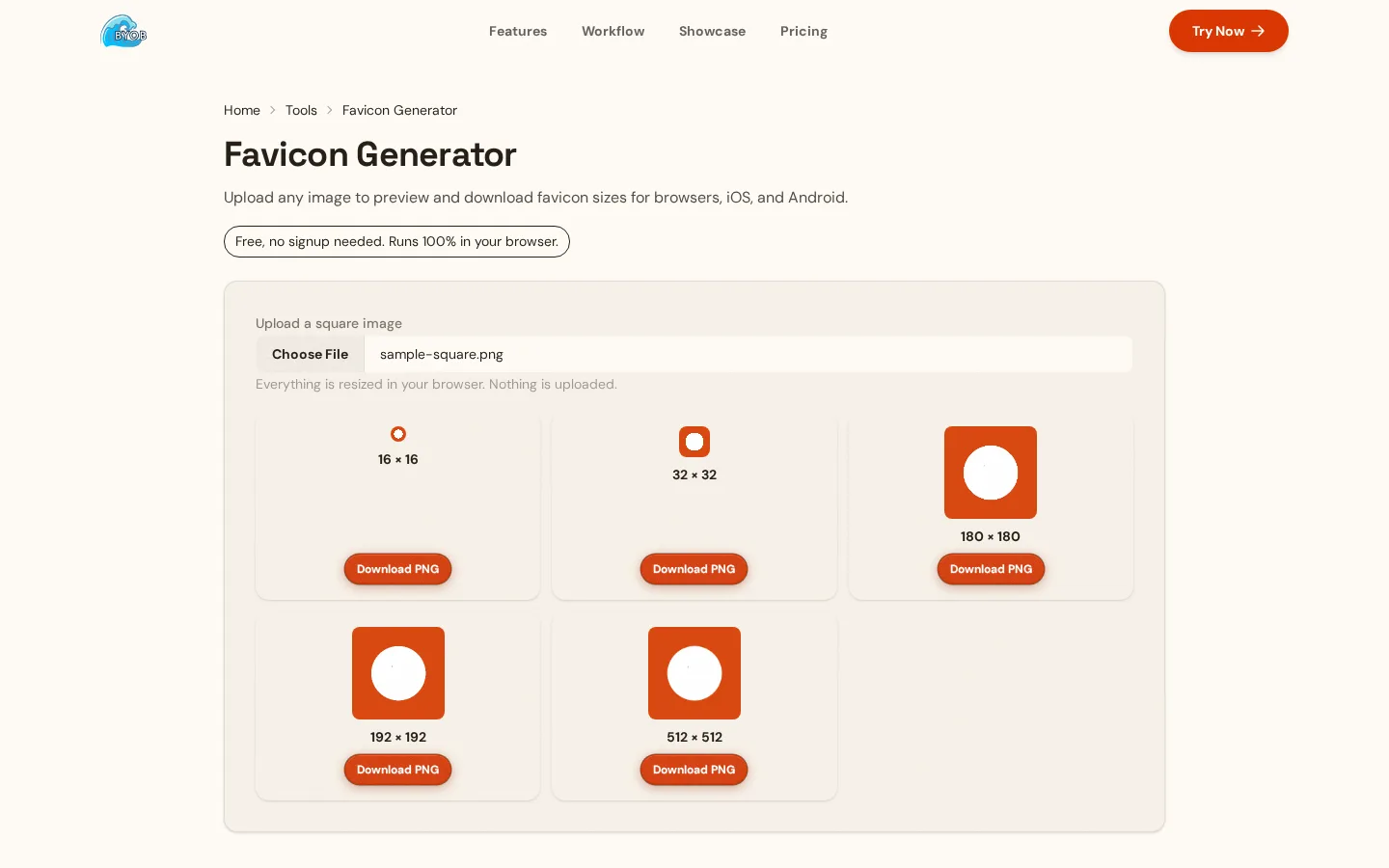
Favicon generation in BYOB reads colors from app css and renders initials to SVG then PNG and ICO, a pipeline checked against app html as the source of truth. The check for a custom link in app html prevents overwriting user branding on redeploys. Concurrency is guarded by a per project lock and a global semaphore, detail we validated against the favicon generator at https://byob.studio/tools/favicon-generator which we verified returns 200.
Who this is for (and who should skip it) #
This guide helps if you want instant branded favicons that respect custom assets already in the project.
If you manage icons by hand in your repo and never want auto generation, you can keep your own file and the system will skip as designed.
One limit to know. Auto generation can only do so much with a low resolution or busy source image. A common mistake is uploading a detailed logo with small text, which turns to blur at sixteen pixels.
- Best for developers automating favicons across frequent redeploys.
- Best for small teams protecting custom icons from overwrite.
- Best for startups wanting clean install and bookmark art.
Summary #
Small details make a platform feel magical, but only when they never misfire. Intelligent detection decides whether generation is needed, async execution keeps it off the critical path, and strict concurrency control keeps it safe at scale. Your project always looks the part, and your custom branding stays yours.
Next time you open a fresh BYOB project, glance at the tab before anything else loads. That little gradient square got there through a pipeline that checked, generated, and got out of the way in milliseconds. Now go replace it with something better. The system will respect that too.
Try it: Favicon generator